3 Purely Elastic Behavior and the Shear Modulus
Why does a rubber band stretch so easily while a steel spring hardly moves – and why do both snap back? An illustrated introduction to Hooke's law, the shear modulus, Poisson's ratio and stored elastic energy.
Hang the same weight on a rubber band and on a steel spring. The rubber band stretches a long way; the spring barely moves. Now take the weight off: both return to exactly their original length, instantly and completely. Nothing has been lost, nothing has flowed away.
In the first two parts of this series we looked at liquids – materials that flow and turn the work you put in into heat. This article looks at the opposite extreme: materials that store the work and give it back. We meet Hooke’s law, the shear modulus as a measure of stiffness, and the spring – the second building block we need to understand real materials such as adhesives, which are part liquid and part solid.
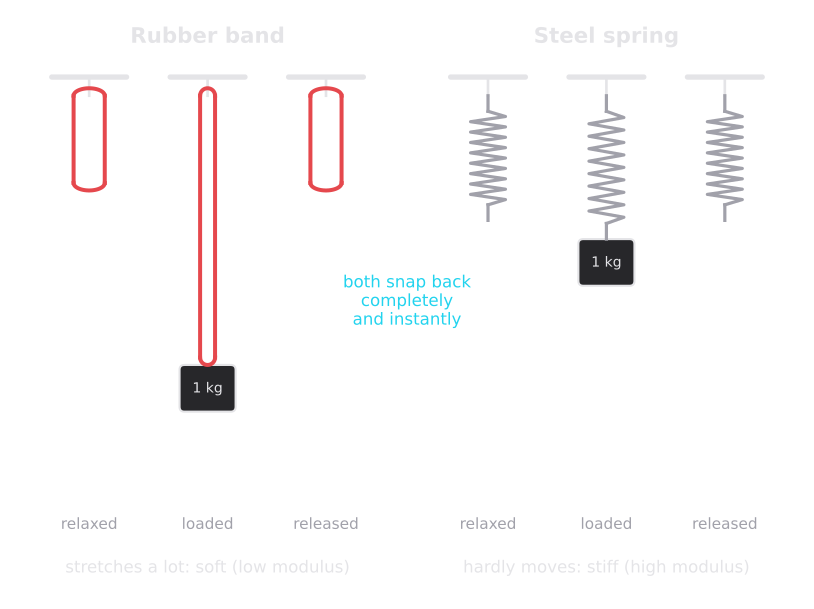
What to look for: the same weight produces very different stretches – but in both cases the deformation disappears completely when the weight is removed.
What Does “Elastic” Really Mean?
In everyday language, “elastic” usually means stretchy: a waistband, a hair tie, a rubber band. In physics, the word means something different: an elastic material returns to its original shape when the load is removed – no matter whether it stretches a lot or only a tiny bit.
By this definition, a steel spring is just as elastic as a rubber band. The difference between them is not elasticity but stiffness: how much force is needed for a given deformation. Physicists describe stiffness with a number called the modulus. Steel has a high modulus, rubber a low one.
An ideal elastic material has three properties:
- Proportional: twice the load gives twice the deformation.
- Instantaneous: the deformation appears the moment the load is applied and disappears the moment it is removed.
- Fully reversible: after unloading, not the slightest permanent deformation remains, and all the energy you put in comes back.
Two Ways to Deform a Solid: Stretching and Shearing
A solid block can be deformed in two basic ways. You can pull on it (tension) or push its top sideways while the bottom is held (shear).
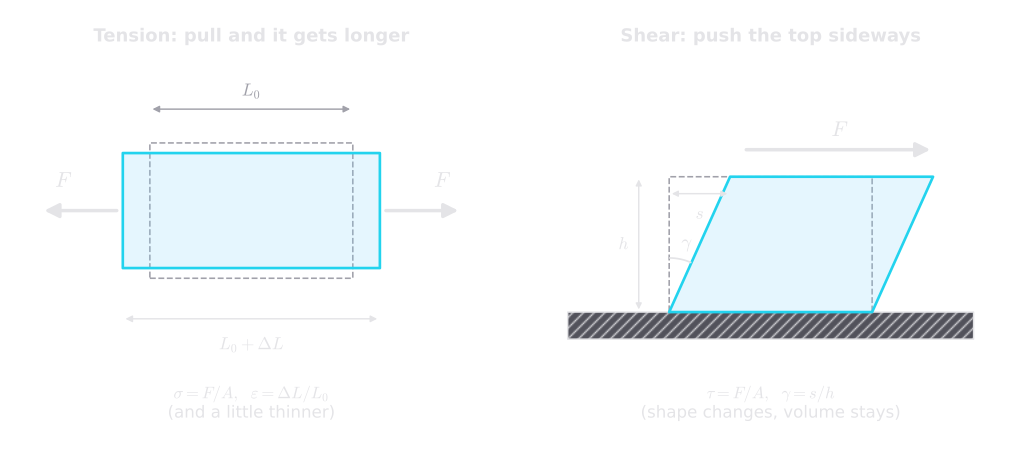
What to look for: in tension the block gets longer (and a little thinner); in shear it changes its shape – a rectangle becomes a parallelogram – but its volume stays the same.
For tension, the load is described by the tensile stress and the deformation by the strain:
In words: the tensile stress (“sigma”) is the pulling force per cross-sectional area, in pascal. The strain (“epsilon”) is the change in length divided by the original length – a pure number, often given in percent.
For shear, we use exactly the quantities from Part 1: the shear stress and the shear strain – the sideways displacement of the top divided by the height.
Rheometers almost always work in shear, because shear changes a material’s shape without squeezing it – and shape changes are exactly what reveal whether a material flows or springs back.
Hooke’s Law: Force and Deformation in Proportion
In 1678, the English scientist Robert Hooke summarized his experiments with springs and wires in a short Latin phrase: ut tensio, sic vis – “as the extension, so the force”. Double the weight, double the stretch. This is Hooke’s law.
Hooke’s Law in Tension
In words: the tensile stress is proportional to the strain. The proportionality constant is Young’s modulus (also called elastic modulus), measured in pascal. A high means: much stress for little stretch – a stiff material.
Hooke’s Law in Shear
In words: the shear stress is proportional to the shear strain. The constant is the shear modulus, also measured in pascal. It tells us how strongly a material resists being tilted.
Plotted as a diagram, Hooke’s law is a straight line through the origin. Its slope is the modulus:
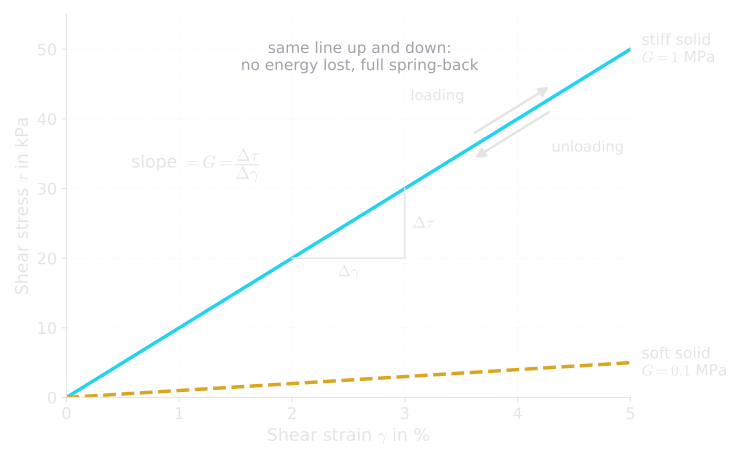
What to look for: the steeper the line, the stiffer the material. The arrows show the most important property of an ideal elastic solid – on the way back, it follows exactly the same line.
Compare this with the flow curves of Part 1. There, too, we had straight lines through the origin, but on the horizontal axis was the shear rate (how fast). Here it is the shear strain (how far). A liquid resists speed; an elastic solid resists deformation.
Worked example. A rubber pad with MPa is sheared by (20 %). The required shear stress is
The same stress applied to steel ( GPa) produces a shear strain of only – about 160,000 times less.
Quick check: Two samples are sheared with the same stress. Sample A deforms by 2 %, sample B by 8 %. Which one has the higher shear modulus, and by how much? Answer: sample A – four times higher, because the modulus is stress divided by strain.
How Stiff Is Stiff? The Modulus Ladder
Moduli cover an enormous range – about ten powers of ten between a hair gel and a diamond. Soft materials like gels, adhesives and rubber sit at the bottom; plastics, glass and metals at the top.
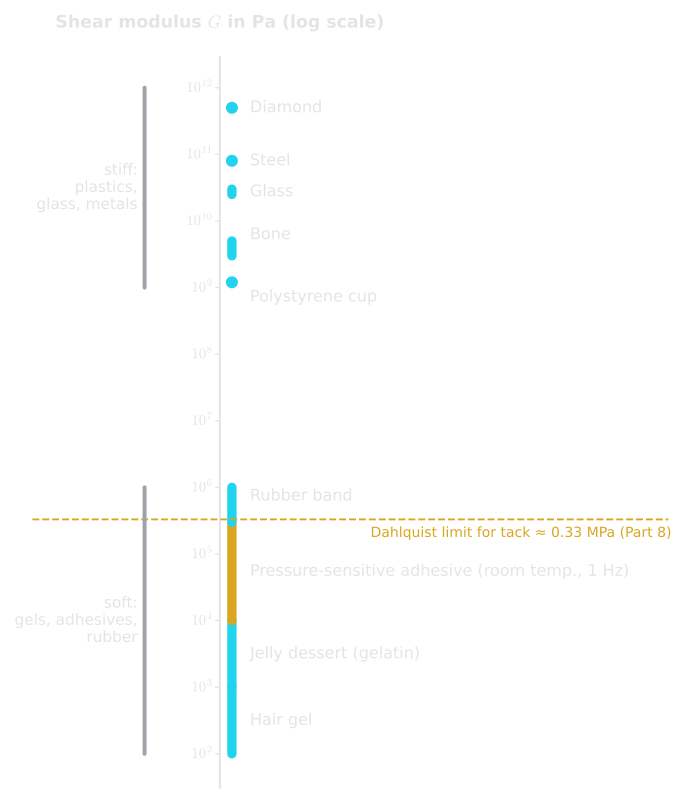
What to look for: pressure-sensitive adhesives (goldenrod) are among the softest solid-like materials we use – softer than a rubber band and just below a special limit that we will meet again in Part 8.
| Material | Shear modulus (order of magnitude) |
|---|---|
| Hair gel | 100–1,000 Pa |
| Jelly dessert | 1–10 kPa |
| Pressure-sensitive adhesive (room temperature, 1 Hz) | 10–300 kPa |
| Rubber band | 0.3–1 MPa |
| Polystyrene (yogurt cup) | ≈ 1.2 GPa |
| Glass | ≈ 25–30 GPa |
| Steel | ≈ 80 GPa |
| Diamond | ≈ 500 GPa |
Common pitfall – stiff is not the same as strong: The modulus tells you how much a material resists deformation, not how much load it can take before it breaks. Glass is very stiff but breaks easily; a rubber band is very soft but can be stretched to several times its length without tearing. Stiffness (modulus) and strength (breaking stress) are two different properties.
Stretching Makes Things Thinner: Poisson’s Ratio
Pull on a wide rubber band and watch it closely: while it gets longer, it also gets narrower. Almost all materials do this. The ratio of sideways shrinking to lengthwise stretching is called Poisson’s ratio (“nu”).
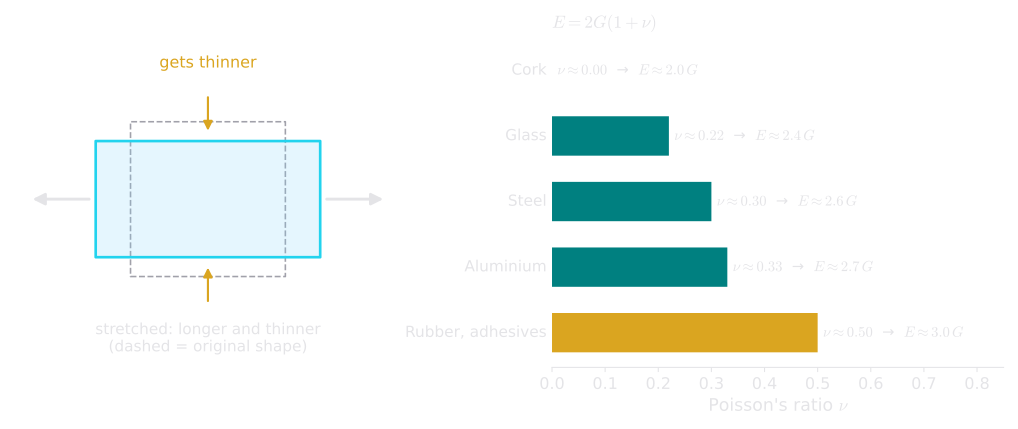
What to look for: rubber and adhesives sit at the maximum value of 0.5 – they keep their volume almost perfectly when deformed. Cork, at the other end, hardly gets thinner at all.
Poisson’s ratio links the two moduli:
In words: the stiffness in tension is always larger than the stiffness in shear, and how much larger depends on how easily the material changes its width. The physical reason: every shear deformation can be seen as a stretch along one diagonal combined with a squeeze along the other diagonal.
For metals, , so . For steel with GPa this gives GPa. For rubber, gels and adhesives, and therefore
This simple rule lets us convert tensile tests of soft materials into shear moduli and vice versa. The reason for is that such materials are practically incompressible: squeezing them from all sides changes their volume thousands of times less than shearing changes their shape.
Everyday example – why wine bottles are closed with cork: When you push a cork into a bottle neck, you compress it lengthwise. Because its Poisson’s ratio is almost zero, it hardly bulges sideways and slides in easily. A rubber stopper () would bulge out and jam in the neck.
Try it at home – the shrinking rubber band: Draw two lines across a wide rubber band with a marker, about 1 cm apart along its length. Stretch the band to twice its length and look at the width between the lines: it becomes noticeably narrower.
Elastic Energy: Stored, Not Lost
When you stretch a spring, you do work. Where does this work go? In an elastic material, it is stored – like in a drawn bow, which releases the energy into the arrow.
The work needed to deform a unit volume can be derived in three steps:
- When the top of the block moves a little further, by , the force does the work .
- Per unit volume (), this becomes .
- Adding up (integrating) all these small contributions with gives
In words: the stored energy per unit volume (in J/m³) is the area under the stress–strain line – a triangle. Because both the height and the width of the triangle double when the strain doubles, the energy grows with the square of the strain.
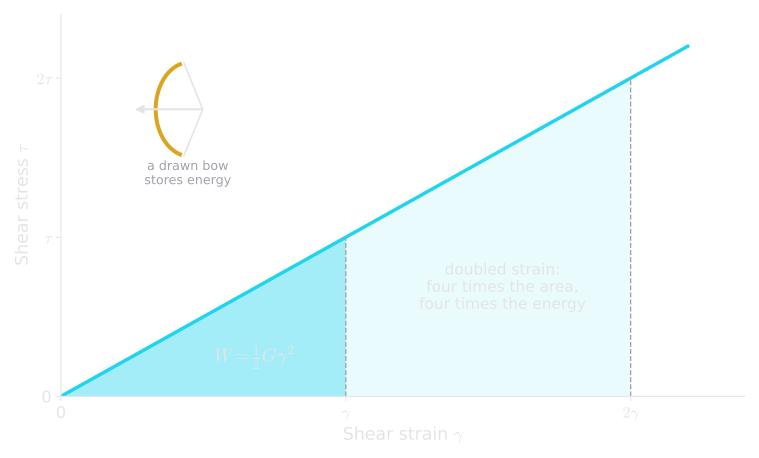
What to look for: the shaded triangle is the stored energy. Doubling the strain makes the triangle four times as large.
Worked example. The rubber pad from above ( MPa, ) stores
When the load is removed, this energy is released completely and the pad springs back. This is the key contrast to Part 1: a dashpot dissipates the work as heat, a spring stores it and gives it back. Real materials do both – and that is the topic of Part 4.
Where Rubber Gets Its Elasticity
Steel is elastic because its atoms are held in a crystal lattice; pulling them apart stretches the atomic bonds like tiny springs. Rubber works in a completely different way.
Rubber consists of long, flexible polymer chains that are tied together at a few points, the crosslinks. Between the crosslinks, each chain is coiled up in a random, disordered way – that is its most probable state. When you stretch the rubber, the chains are pulled into more ordered, straightened shapes. When you let go, they spring back into disorder, simply because disorder is far more likely. Rubber elasticity is therefore driven by entropy, the physical measure of disorder.
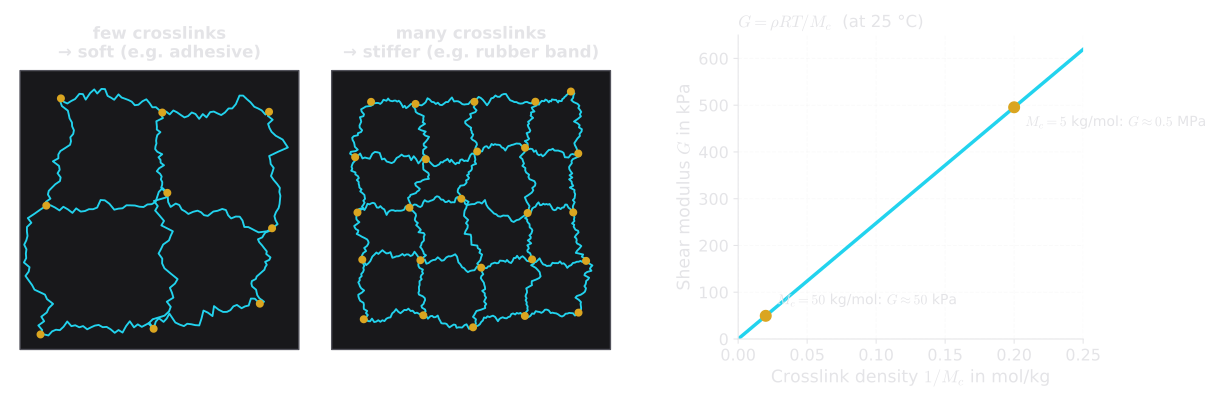
What to look for: more crosslinks mean shorter chain segments between them – and a stiffer network. The modulus grows in direct proportion to the crosslink density.
The theory of rubber elasticity gives a remarkably simple formula for the shear modulus:
In words: the modulus grows with the density of the material, with the absolute temperature and with the gas constant – and it falls with the molar mass of the chain segments between two crosslinks. Short segments (many crosslinks) mean a stiff network; long segments (few crosslinks) mean a soft one.
Worked example. At room temperature ( K) and :
- kg/mol gives MPa – a typical rubber band.
- kg/mol gives kPa – the range of a pressure-sensitive adhesive.
A surprising consequence: because the elasticity comes from disorder, rubber gets stiffer when it is warmed – the opposite of what metals do.
Try it at home – a rubber band that feels warm: Hold a thick rubber band against your upper lip (which is very sensitive to temperature) and stretch it quickly. You feel it get slightly warmer. Let it relax quickly and it feels cooler. This is the entropy at work: ordering the chains releases heat. If you hang a weight on a rubber band and warm it with a hair dryer, the band even contracts and lifts the weight.
The Limits of Linear Elasticity
Hooke’s law is not valid forever. Every material has a limit beyond which the straight line starts to bend: the structure begins to rearrange, slide or break.
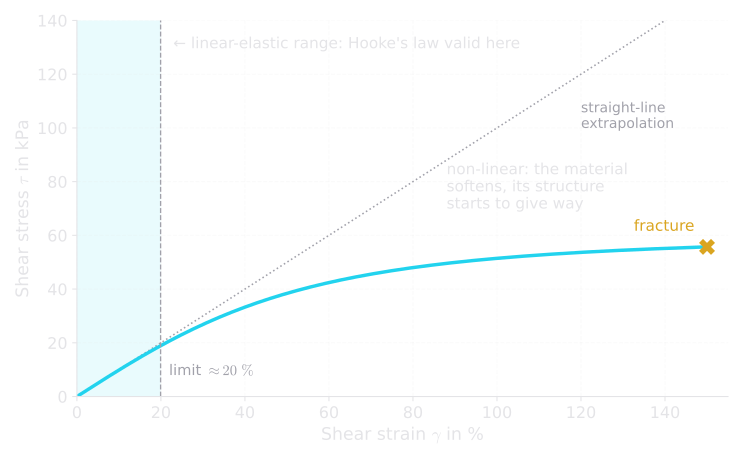
What to look for: up to the dashed line, the curve follows Hooke’s law. Beyond it, the material softens – the same stress now produces more and more deformation – until it finally breaks (model data).
For steel, the linear range ends at a strain of only about 0.1–0.2 %. For rubber it can reach 50 % or more. For soft gels and pastes it is often below 1 %. Knowing this limit is essential for every measurement: moduli are only meaningful as long as the test stays inside the linear range.
In the lab: Rheometers determine the shear modulus of soft materials with very small, gentle deformations – usually a slight back-and-forth twisting, as we will see in Part 7. The first step of such a measurement is always to find the linear range, so that the test does not change the structure it is supposed to measure.
The Spring: Symbol of Elasticity
In Part 1 we met the dashpot as the symbol of an ideal viscous liquid. Its counterpart is the spring, the symbol of an ideal elastic solid. In all diagrams of this series, the spring is drawn in cyan, the dashpot in teal.
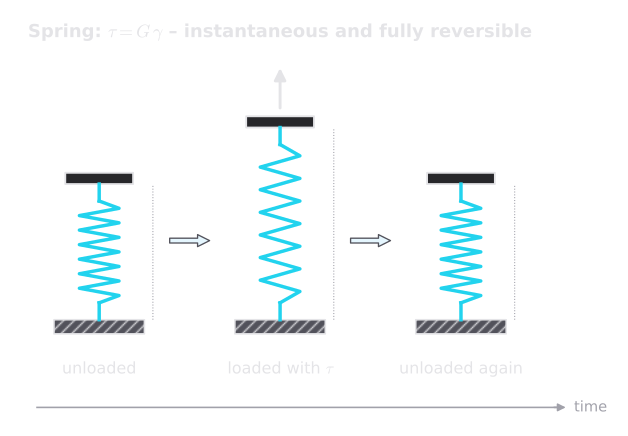
What to look for: the spring’s length in the first and third picture is identical – no memory of the load remains.
The difference between the two building blocks becomes most obvious when both are loaded in the same way – a constant stress switched on at time zero and off again at time :
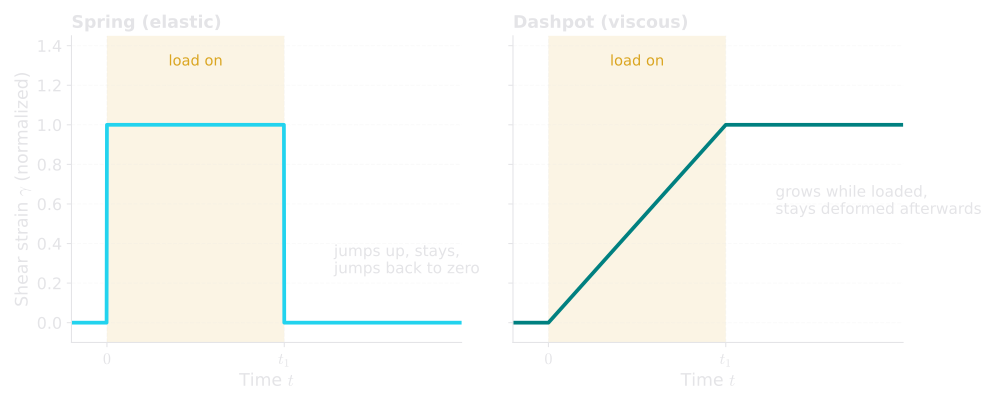
What to look for: the spring responds instantly and forgets everything; the dashpot responds slowly and remembers everything. Real materials lie somewhere in between.
| Spring (ideal elastic) | Dashpot (ideal viscous) | |
|---|---|---|
| Law | ||
| Responds to | deformation (how far) | deformation rate (how fast) |
| Timing | instantaneous | grows over time |
| Energy | stored and given back | converted into heat |
| After unloading | returns to original shape | stays deformed |
Why It Matters for Adhesives
A pressure-sensitive adhesive must make contact with a surface under nothing more than light finger pressure. That only works if it is soft enough to deform into the tiny roughness of the surface. In the 1960s, the adhesive scientist Carl Dahlquist found a simple rule for this: an adhesive only grabs on light contact if its modulus stays below about a third of a megapascal. This Dahlquist criterion – drawn as the goldenrod line on the modulus ladder above – is one of the boundaries of the Chang Viscoelastic Window in Part 8.
Adhesive formulators control this stiffness exactly as the rubber formula predicts: by adjusting the number of crosslinks. Fewer crosslinks make the adhesive softer and tackier; more crosslinks make it stiffer and give it more internal strength. Because adhesives are nearly incompressible, the simple rule also lets us compare tensile and shear measurements.
Key Takeaways
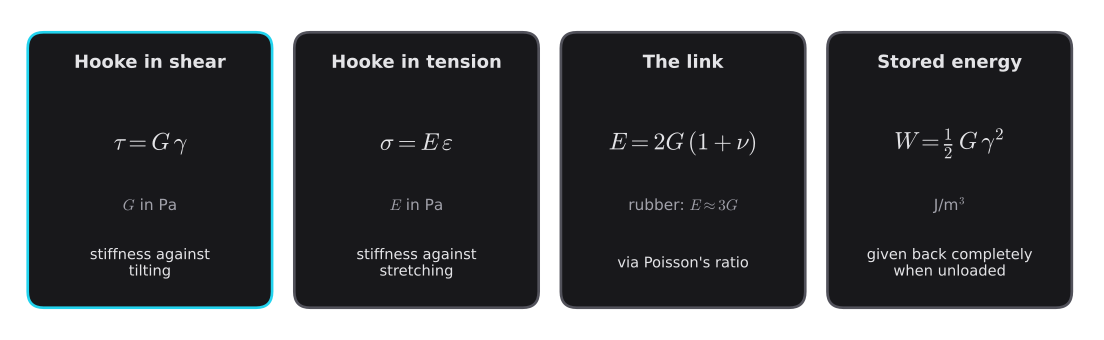
- In physics, elastic means “returns completely to its original shape” – not “stretchy”. Stiffness is a separate property, described by the modulus.
- Hooke’s law: in shear and in tension – deformation proportional to load, instantaneous and fully reversible.
- Shear modulus and Young’s modulus are linked by Poisson’s ratio: ; for rubber, gels and adhesives .
- Elastic deformation stores energy (), viscous flow dissipates it.
- Rubber elasticity comes from the disorder of polymer chains; the modulus is set by the crosslink density () – the main lever for adhesive stiffness.
- Hooke’s law only holds within the linear range; every measurement must stay inside it.
Key Terms
| Term | Meaning in plain language | Symbol, unit |
|---|---|---|
| Elastic | Returns completely to its original shape after unloading | – |
| Tensile stress, strain | Pulling force per area; relative change in length | , Pa; , – |
| Young’s modulus | Stiffness against stretching | , Pa |
| Shear modulus | Stiffness against tilting (shear) | , Pa |
| Hooke’s law | Stress proportional to strain | , |
| Poisson’s ratio | How much a material gets thinner when stretched | , – |
| Stored elastic energy | Work stored in a deformed elastic material per volume | , J/m³ |
| Crosslink | Chemical tie point between polymer chains | – |
| Linear range | Deformation range in which Hooke’s law holds | – |
| Spring | Mechanical symbol of an ideal elastic solid | – |
Coming Up Next
Silly Putty bounces like a rubber ball but spreads into a puddle when left on the table overnight. Memory foam slowly gives way under your hand and slowly returns to its shape. In Part 4 we combine the spring and the dashpot to describe such viscoelastic materials – and find out why stirring bread dough makes it climb up the kneading hook.
References
- Mezger, T. G.: The Rheology Handbook, 5th ed., Vincentz Network, Hanover 2020.
- Macosko, C. W.: Rheology: Principles, Measurements, and Applications, Wiley-VCH, New York 1994.
- Treloar, L. R. G.: The Physics of Rubber Elasticity, 3rd ed., Oxford University Press, Oxford 1975.
- Ashby, M. F.; Jones, D. R. H.: Engineering Materials 1, 4th ed., Butterworth-Heinemann, Oxford 2012.
- Dahlquist, C. A.: Pressure-sensitive adhesives. In: Patrick, R. L. (ed.): Treatise on Adhesion and Adhesives, Vol. 2, Marcel Dekker, New York 1969.