AIAG Quality Summit 2026: AI, ISO 9001:2026, the New SPC Manual and One Book for IATF 16949
Four takeaways from Novi: where AI really helps in quality management, what ISO 9001:2026 changes, how the harmonized AIAG & VDA SPC manual redefines stability and Cpk – and why IATF 16949 and ISO 9001 are set to share one book again.
On 23–24 September 2026, the automotive quality community met in Novi, Michigan, for the AIAG Quality Summit. The motto was “Elevating Standards in the Age of AI”, and it fitted: seldom have new tools and new rulebooks landed at the same time. Four topics stood out.
1. AI in Quality: a Thought Partner, not the Decision-Maker
Almost every AI talk arrived at the same conclusion: AI makes quality work faster – but the human remains accountable.
The most striking number came from BorgWarner. An AI agent checks engineering work products (requirements, test cases, change and problem records) against Automotive SPICE. Combined with human oversight, it achieved 100 % review coverage in about 7 % of the time a manual review would need – and found more issues earlier.
Magna and the Michigan Manufacturing Technology Center showed AI in root cause analysis. Think of it as a sparring partner in an 8D team: it drafts a clean problem statement, proposes hypotheses beyond the usual suspects, sorts data by shift, machine and batch, and challenges a 5-Why chain that stops too early. The clear division of labour:
| AI can help with … | Humans still own … |
|---|---|
| structuring facts vs. assumptions | the Gemba investigation |
| generating and ranking hypotheses | technical judgement |
| finding patterns in messy data | validating the data |
| drafting 8D action plans | the final decision |
The guardrails were equally clear: no conclusion without evidence, AI output is a draft, no confidential data in public tools, and every action must flow back into PFMEA, control plan and SPC. Or, as MMTC put it: “The advantage is not using AI to get answers. The advantage is using AI to ask better questions.”
Bosch added the necessary warning: “AI amplifies the operating model it enters.” In fragmented organizations it only produces faster silos. In one field case affecting more than 750,000 vehicles, the first symptoms appeared in August 2021; the corrective action came in June 2023. With data-driven OEM–supplier collaboration, Bosch estimates the issue could have been caught more than a year earlier.
2. ISO 9001:2026: Quality Culture Becomes a Requirement
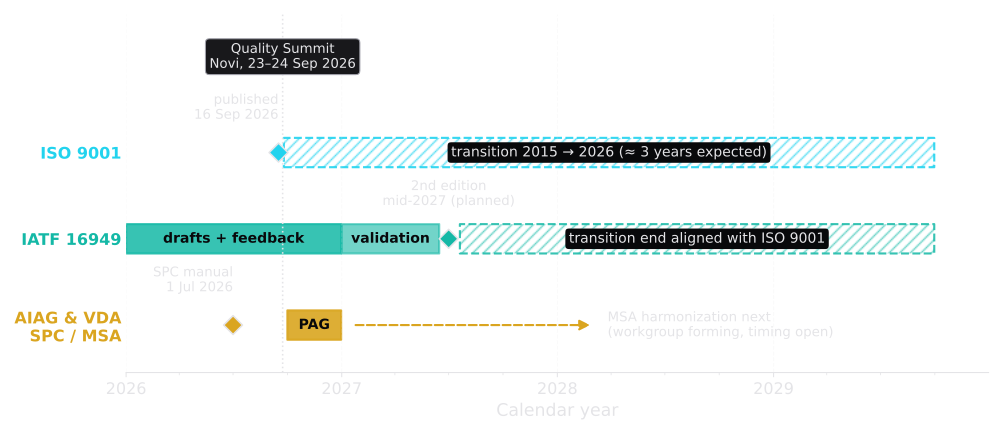
ISO published the new edition on 16 September 2026, one week before the summit. It is an evolution, not a revolution: harmonized structure, a clearer separation of risks and opportunities, stronger change management. The real novelty is quality culture and ethical behaviour as an explicit requirement:
- 5.1.1 i) – top management shall promote quality culture and ethical behaviour,
- 7.1.4 – the operating environment depends on the quality culture,
- 7.3 e) – people must be aware of it.
But how do you audit culture? Plexus suggested looking at the behaviour under pressure. An iceberg helps: visible behaviour on top, the organization’s history below, shared values at the bottom. An incident pyramid provides early warnings, from casual comments (“we just skim the checklist”) via workarounds and near misses up to recalls. Per process, a Quality Culture Strength Index can be scored – in the example, the contract review process reached 29/40 = 72.5 %.
The usual three-year transition (until roughly autumn 2029) is expected, but at the time of writing the formal transition rules from the accreditation bodies were still pending.
3. The Harmonized AIAG & VDA SPC Manual
Since 1 July 2026, one common SPC manual from AIAG and VDA replaces the previously diverging regional approaches (AIAG SPC 2nd edition from 2005 and VDA guidance). GM’s Tracy Bojarczyk summarized the most important changes:
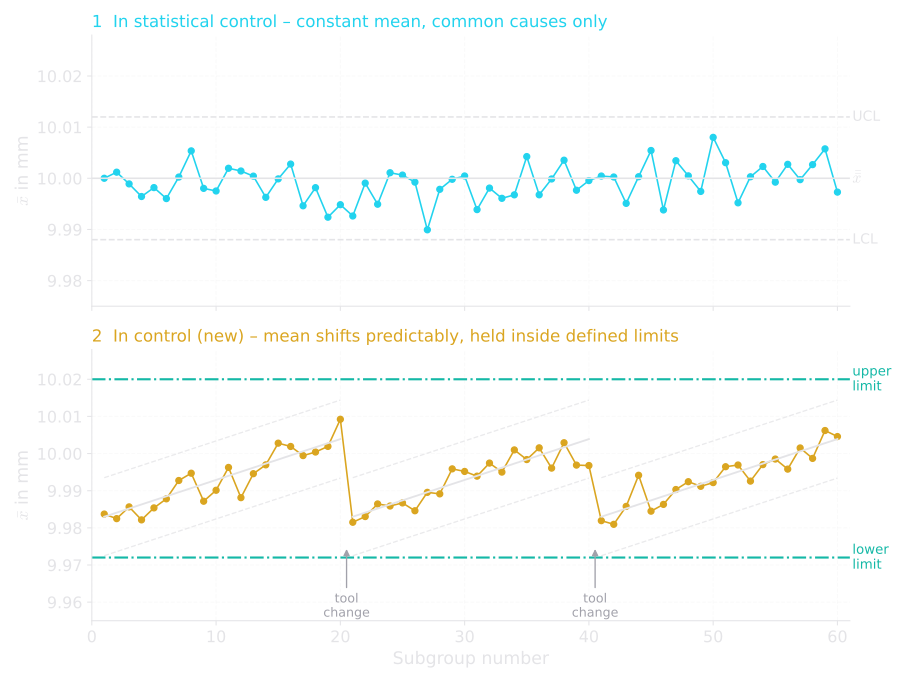
Two controlled states instead of “stable/unstable”. A process is in statistical control if only random variation remains. New: it can also be in control if its mean shifts in a known, predictable way – e.g. through tool wear – and stays within defined limits.
Stability decides between P and C. Formerly, the formula decided the index – so a “Cpk” could be reported for an unstable process. Now the study type and stability come first:
- Pm/Pmk – machine performance,
- Pp/Ppk – preliminary or not yet stable processes,
- Cp/Cpk – only for demonstrated stable or in-control processes,
- Cw/Cwk – the old “within-subgroup Cpk”, now for analysis only.
All reporting indices share one equation; only the estimates change. For normal data:
For non-normal data, the median and the quantiles and replace and .
In addition, there are time-dependent distribution models (TDDM) according to ISO 22514-2, a selection guide for EWMA, CUSUM, Pearson and multivariate charts, and six connected control loops from the control chart up to the system audit. A Practical Application Guide is due in Q4 2026; harmonization of MSA is next.
4. IATF 16949: Back to One Book
Harald Wilhelm presented the new IATF AISBL, a legal entity under Belgian law. For the first time, the IATF can sign contracts, hold intellectual property and act more firmly against weak certification bodies.
The 2nd edition of IATF 16949 is planned for mid-2027. It will incorporate all Sanctioned Interpretations and FAQs, adopt the harmonized structure of ISO 9001:2026 and focus on five topics: simplification, software quality, Tier-N management, launch management and customer-specific requirements. The end of its transition will be aligned with the ISO 9001 transition.
The biggest news for practitioners: the IATF is negotiating with ISO to include the full ISO 9001 text in the new edition – either side by side or as “boxed text”, as in the old ISO/TS 16949. The constant switching between two documents would then end. It is not final yet, but it is a clear goal.
What This Means for You
- Start the ISO 9001:2026 gap analysis now – with quality culture as a process topic, not just a poster.
- Check your SPC procedures and software – especially Cpk vs. Ppk reporting and the definition of stability.
- Plan one combined transition for ISO 9001 and IATF 16949 instead of two projects.
- Pilot AI where evidence is structured – in 8D, reviews and data analysis, always with a human in the loop.
References
- AIAG Quality Summit 2026, Novi (MI), 23–24 September 2026 – presentations by BorgWarner (Bovenzi, Balasubramanian), Magna (Dakshinamoorthy), MMTC (Johnston), Bosch (Glissnik, Doig), Plexus (Vivone), GM (Bojarczyk) and IATF AISBL (Wilhelm).
- ISO: ISO 9001:2026 launch announcement
- AIAG: Quality Summit 2026
- AIAG & VDA: Statistical Process Control (SPC), 1st edition, 2026.
- ISO 22514-2: Statistical methods in process management – Capability and performance – Part 2: Process capability and performance of time-dependent process models.